Words by Angelina Singer
At the risk of sounding super cheesy, I’ll admit that logging on to chat with Patty Walters of As It Is felt like catching up with an old friend. He smiled instantly, greeting me by name (which is already so classy), and made me feel right at home. I mentioned immediately that I felt like I’d grown up with Patty, because I’ve followed his music and watched a lot of his hilarious older videos (“Song About a Girl”, for example — if you know, you know). But of course, now we’re focusing on the brand new As It Is album, which is self-titled — a really clever thematic nod to the band itself, especially after various lineup fluctuations and a hiatus.
After their grittier, and arguably more angsty recent albums The Great Depression (2018) and I WENT TO HELL AND BACK (2022), this self-titled experience feels like a sort of coming home to yourself. I noticed, upon comparing the themes and overall sound of this new album to the others, there’s a greater focus on the internal battles of being a human being, as opposed to more of a focus on the external, more sociopolitical ideas of the previous ones. And don’t get me wrong, my angsty side definitely enjoyed plenty of the other albums as well, but there’s something so soothing and special about this self-titled album. That’s why I’m so grateful I got to talk to Patty about it and learn more at a deeper level from the frontman himself. You can also read my recent review of their live EP here.
After saying hello and getting some purely conversational things out of the way (like mentioning how I made a crocheted doll of him that another fan bought from me, to give to him years ago, which ended up appearing on Digital Tour Bus), I asked him about how the idea for this album came about.
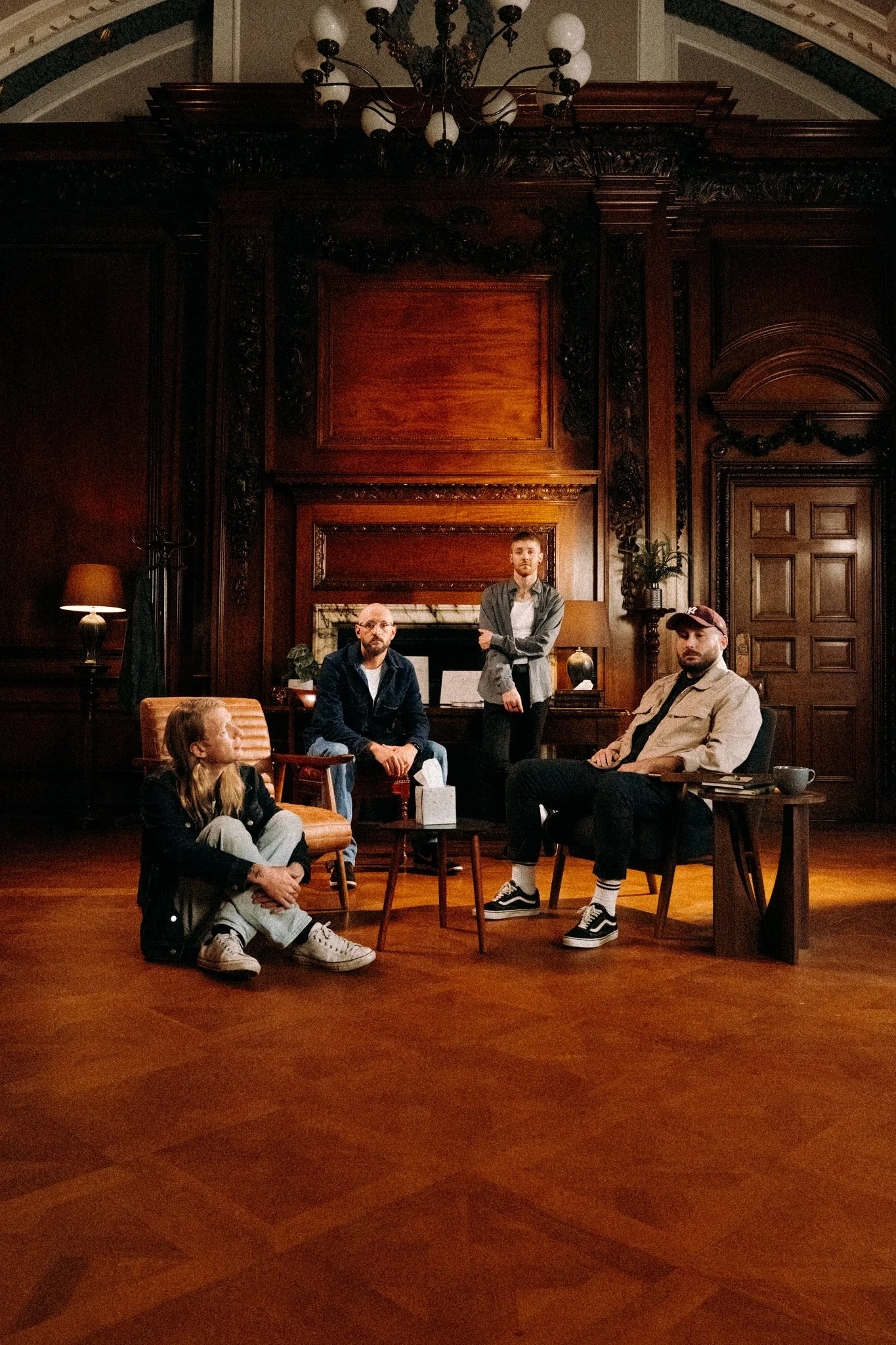
Photo by Ashlea Bea
“The band was a couple years deep into the hiatus, it didn’t look possible for us to all get together and come back as things were. So we started sort of, writing some new music — not necessarily for As It Is, but because we’re like artists and musicians at the end of the day. It’s how we sort of make sense of the world and our feelings and our struggles and our humanity… after a while, it started becoming really clear that these were As it Is songs. And that if the band were ever to come back, we would love to release at least an EP, but certainly another record. And then it was finally possible for all sorts of cosmic, serendipitous reasons that we could get together and get on stage… but it all started with the new music, it all started with the songs. It all started with ‘Lose Your Way and Find Yourself’ as the first re-introduction to making art and calling it As It Is.”
Patty went on to explain that the recent re-recordings and anniversary album work they just put out for Never Happy, Ever After really solidified the idea that this was the right time to re-establish the band’s sound and highlight the current four members as being who the band is and always was meant to be. “It’s the four of us, or it’s none of us, basically,” he added.
From there, we chatted a bit more before I brought up my absolute favorite lyrics from this album. It’s from “Lose your Way and Find Yourself” — “It all looks like madness / too close to the canvas”. So good, and such a relatable mantra that I’m definitely adopting into my daily mindset habits to remember the importance of zooming out and not getting caught in the weeds of life.
“Thank you, it’s something that I’ve just been saying in my life for years. I don’t think I’ve been saying [the bit about] the madness part, but I’ve been saying that I was too close to the canvas about like albums for so long. Because when you’re looking at it up close and it’s such a big picture, broad project, you totally lose perspective. You just zoom in on the minutia and the microscopic. Sometimes you need to take a step away, sometimes you need time to get that perspective… Something that I’ve been quoting a lot, is — I listened to a lot of podcasts like over lockdown. There was one that an actor was saying about how long he’d been doing it, and just like, we always strive for greatness and perfection, but at the end of the day, we’ve been doing this so long, that’s it’s always gonna be good. Like it’s never gonna be bad anymore. We’re too many years deep and too many experiences deep to be giving bad performances now, we’re always aiming for great. But it’ll always be at least good.”
Patty expanded a little bit here on finding the right balance of pushing yourself for greatness but also acknowledging that it’s totally valid to take some confidence from your previous experiences and celebrate what you’ve learned throughout them. It’s a very humble, but honest approach that I think would help a lot of people to master (myself included because imposter syndrome is such a real thing for probably everyone at one time or another).
My next question was a bit more serious lyrically, but I wanted to ask because I was genuinely perplexed at the meaning, but I knew it was likely something super smart and impactful once it was puzzled out. The lyrics in question are “You’ve got me feeling so alive / like sunshine yeah / and like suicide”. There’s gotta be something deeper in this high-energy song titled “So Alive” — and Patty was more than happy to explain a little more about that for me. And the answer, was both impactful and surprising. My guess was that when people get to the mental place where they want to end their life, suddenly, they’ve never felt more alive than they do in that moment — hence, the idea of suicide being a sort of jolt back to reality.
“Yeah, and I have been there, so that is true and it’s just sort of like you can’t have one thing without the opposite of itself. That’s sort of the double-entendre, but that song is really cool, because it’s more literal than it sounds a lot of time, because it’s about — in 2018, I had a blood clot. And I was on blood thinners for like two, maybe three or four years. And taking these pills that would make me bleed more than normal, made me feel really vulnerable. And when you’re touring, you’re just in vans and buses and planes and stuff, and you’re just like ‘Oh this is scary because I’m taking medication that makes me even more vulnerable than people in their bodies already are’. So it’s just sort of about feeling really scared and really anxious about how human and vulnerable I was. As soon as you know that, the first lyric in the verse is ‘another city, another small pink pill,’ ‘cause I was just taking these small pink tablets that were blood thinners. But yeah, ‘You’re in my blood and every part of me / you’re the only one that tells my heart to beat’ and it’s just all this stuff about how these things are keeping me alive, but they’re also making life feel really scary.”
It’s the duality of these two things (“sunshine” and “suicide”) that he’s playing with in these lyrics, and I really enjoy the clever way he totally plays into the fact that people are most likely not going to think of blood thinners with these lyrics. Best I could imagine, they might think he’s referring to some hypothetical past romantic relationship, or maybe recreational drug usage. That’s why I found this incredibly intriguing and smart — just like so many of the other lyrics on this wonderful album. He also suggested that these lyrics could hint at the band getting back together, as in, they’re so alive again — so there are multiple ways to read this line.
This is also an interesting commentary on making lyrics vague enough to be relatable, even if they actually have a very specific meaning to the artist. “That’s the thing too, in some of the earlier songs that we wrote, in trying to make them more relatable to people, sometimes you really try to like, broaden what you’re saying. But in actuality, some of the lyricists that I’ve connected with most — Justin Pierre from Motion City Soundtrack and Dan Campbell from The Wonder Years — like, being really specific and mentioning people by name and places by name, and moments as they happened. The more specific you make them… we’ve all had experiences that are similar, so it was fun with that one to remember, the more specific I make this, it’s my truth at the end of the day — it’s fun as an artist…”
I really appreciated this behind-the-scenes look at what it takes to write songs like this, and I felt like it really played well into the earlier-mentioned dichotomous situation of alive when almost dead, and in this case, specific while being super vague at the same time. From here I wanted to continue my questions about specific songs, and learn more about the song “Marilyn”.
“There’s parts of it that are true to my life, and parts of it that aren’t. But basically, how the song came together, was a year-and-a-half ago, Ben [Biss] and I went to this songwriting camp, at the Marshall Amp Studio in Milton Keynes, and that was day one of two for us. And we got paired up with one person we knew already — a producer named Steffan, he’s amazing… [and two others they’d never met before] we didn’t know if we were writing for As It Is or somebody else, but we started writing this song, and it started quickly. In the first ten or so minutes, we were realizing it was probably gonna be an As It Is song, and we just started describing small towns and the people you would see around them… You leave your small town for somewhere more exciting and full of color and life, and then when you come back to where you grew up that it looks a little different.”
I think everyone can relate to the desire to get out of the place they grew up in, and then miss it when they come back and it’s never quite the same. I mentioned to Patty that this song makes me think of my uncle who passed away but really supported me, and taught me a lot of life lessons that he only knew from his own movie-worthy life experiences.
“Marilyn is like the name of somebody that I knew, but so much of it is sort of like the idea of the story and that character being in your adolescence and your early life, maybe even your early adulthood and things. But also just how no one really ever dies, people sort of live on in other people and how they’ve impacted other people in their spirit and their behavior and their attitudes, and how they treat people. So it’s kind of about that more than anything else. Again, it’s super literal in that it’s about a person, and we talk about her name, and her body, and her personality, and her attitude towards life, but it’s also just broadly about how people make really big difference[s]. Sometimes we can be really obsessed with living a life that’s in the history books, but we’re all written in the history books of each other…”
This is probably my favorite song on the album, and that’s really saying something, because this album is stacked front-to-back with amazing tracks. Although, Patty admitted that it’s one of his favorites from the new album too. And, it was written all about this sweet lady who was a volunteer at the charity shop he worked at. I bet she would be so honored if she knew the impact she made on him. Similarly, I named my Maltese puppy after my uncle — that’s totally the same thing, right? Right?
Switching gears, I was also really intrigued by the biblical references in the song “Turn to Dust” — which Patty revealed, was completely coincidental, but still interesting, nonetheless. “It’s not intentional, it’s all just like happy coincidence and stuff. But I suppose when you talk about the meaning of life and death and things, it’s gonna sort of come across that way at times. But I love that it’s doing so unintentionally, that’s fun.”
But coming back into the nitty-gritty of the song itself, Patty offered these helpful insights around what inspired him to write this one:
“There’s a lot of angst in each verse about ‘I thought I’d die by 27 / that’s what everybody says’, just like, we all see death differently when we’re kids and teenagers than we do as adults. But it’s just about this idea, maybe frustration, maybe the dichotomy of ‘we’re here and we’re alive’ and then it all ends the same for all of us and there’s nothing we can do to change that. We can make it as beautiful as we possibly can, but we can’t change the ending — or, as we say in the song, ‘we can’t outrun the ending’. I loved the imagery and the poetry of ‘we race ‘til we rust / we dance ‘til we turn to dust’. And then the bridge is this almost spoken word type of thing about how just life being ruled by capitalism is exhausting and it doesn’t always feel fair, and it doesn’t always feel fun. But we’re here to live and make the best of it. And that’s not easy, but it’s also our obligation, to ourselves and to everybody else.”
Patty also recalls that this one has become one of the new fan favorites, and that people seem to really love singing along to it at their live shows. In fact, people have been loving it so much, that he muses they might have to make a full music video for this one — and if they do, you can say you heard it here first!
And of course, I noticed the thematic parallels from “Turn to Dust” and “Live, Love, Laugh, Los Angeles”, in the sense that both are calling out the pitfalls of society, where things are just hard to afford and many things economically don’t make sense. The line about not being unable to afford an ambulance is something that anyone would agree is an issue, regardless of where they stand politically.
“We can call it political, but being someone who is American living in the UK, it’s not political to just notice that that ain’t right. The system is too broken when that is how it operates… and the wordplay and the rhymes in the chorus were super fun from like ‘televangelist’ to ‘ambulance’… it was really fun just… flexing my Eminem muscles. Just trying to make the rhymes as weird and unconventional as they could possibly be. That one’s one of the ones I’m proudest of. It started during the hiatus of the band, and we didn’t know if it was gonna be on the record or not. We sort of finished it last, recorded it basically last, and changed a lot of the lyrics like in the studio, right at the finish line. And it wasn’t even until we’d left the studio, that we got Justin Klunk playing the saxophone on it… without the saxophone, the song simply doesn’t work.”
I can’t remember any other time they’ve had saxophone on any other album they’ve recorded, so this was a really surprising component. “This record has more live instruments than we’ve ever used on a record before. So there’s saxophone, there’s mandolin, there’s turntables, there’s banjo, there’s more guest vocalists than we’ve ever had on a record. That was the biggest joy — we all start bands and musical projects to play instruments. As fun as it is to create loops and dig through samples, there’s nothing more fun than just playing an instrument.”
He went on to explain that he and the rest of the band were daring enough to add instruments they don’t even know how to play — they just played them until they sounded the way they wanted, which is so bold and inventive. And of course, learning them enough to be able to at least play them the same way twice must have been a challenge. Mandolin was one example of an instrument the band didn’t really know, and Patty himself mentioned being relatively self-taught on piano and keyboard. And on top of it all, everyone in the band was also singing background vocals and harmonies — that’s probably why the sound feels so full, because it is!
As we got closer to the end of our chat, I mentioned to him how I perceived this album as a thematic shift toward inner thoughts and nostalgia, as opposed to being predominately the external, political context as seen in their previous work. He agreed but admitted that it wasn’t an intentional shift.
“It’s more how it just came together. We were just trying to write what had to be written about. We’d been through so much, through the turbulent and dormant years of the band, there was so much for us to process — not just in the art and in the lyrics, but in counseling and in therapy, and reinventing the landscape of our personal lives. So that took the priority. And the thing too, we tried to write lyrics the way that we used to, and it just didn’t feel authentic anymore, and we needed to really rethink how we write these lyrics. Instead of coming from a place of negativity and self-deprecation all the time — which has worked for four records and our early EP’s, it really had to be more about healing, optimism, hope, and just sort of life… as we’re seeing it all around us.”
Before logging off, I wanted to get a couple quick answers to some burning questions before the videochat ended, so I asked Patty about what life events inspired “Not Anymore”.
“That one has a lot in common with a song of ours called ‘Still Remembering’, which is the idea of there’s a lot of uncertainty in my life, maybe this band thing is gonna be around for a while, maybe a lot in my life has gotta change. So placing it in this sort of imagery of, a romantic breakup, and just the questions and the uncertainty and the heartbreak of all of that, to explore just a lot of doubt and a lot of fear, and a lot of grief about losing something really important to us and to me. That’s sort of how it started, but again, to make it feel as vivid and as real as possible, and talking about the apartment that was maybe never actually too small; maybe it’s actually something more symptomatic of us, and this doesn’t work anymore. And yeah, months by their names and things, it was really fun to play with, specific details, I suppose.”
I really appreciated his connection to a precious song in their discography, one that really allows listeners to think about their own struggles and reflect on the lessons they’ve learned along the way. And in this case, Patty acknowledged that a previous heartbreak experience was really the fuel that inspired this particular track on the new album.
My last question for Patty really just was about wanting to know what he wanted fans to take home from listening to this album, and what they could expect for the future of the band.
“If people take away anything from the record, I just hope that they feel the between half and a full hour that they spent listening to it was fun, and worth it. I think we all just wish we had more time in the day for all the songs and art and media that’s out there. We only have so much of it, so I just hope that they enjoy spending time with our fifth record. The record we’re maybe the most proud of — we’re a little biased because it’s just come out this year. But really proud of it, and we’ve been back in a big way for… exactly two years of publicly being back and celebrating As It Is, and you know, writing new music and playing shows again. The plan is to keep that rollin’ and keep playin’ shows, the goal is to continue writing records, so I hope just as much as you that this is where that leads us.”
Huge thanks to Patty Walters for taking the time to chat about all these wonderful topics, and to introduce our readers to their fifth, self-titled album, As It Is. You can listen to the whole thing now available on Spotify and other streaming services!